Building stronger foundations
The £2.6m Strategic Grant programme from the Henry Smith Foundation funded 15 organisations to provide independent and non-statutory advocacy for people with learning disabilities and/or autistic people across the UK between 2022 and 2026. Social Finance was the learning and evaluation partner for the programme, supported by Speakup as our lived-experience partner. Our aim was to build evidence on the value and impact of advocacy, and to explore the advocacy sector’s routes to sustainability.
Our 2025 report from the first phase of the programme, Independent advocacy for independent lives, showed that grantees reached and supported more than 1,667 individuals. Advocacy had a positive impact on people’s lives and led to measurable improvement across advocacy success outcomes – such as speaking up, knowledge of rights, and knowledge of local services.
Cost-benefit analysis from the first phase showed that non-statutory advocacy generated benefits worth £12 for every £1 spent. Approximately £7 of these savings accrue to the National Health Service, with £5 going to local authorities.
This report builds on our 2025 report (and is designed to be read together with it), exploring ways the sector can become more sustainable. We examine areas where the sector needs additional support, assess whether and how it could benefit from a sector body, and explore pathways to greater financial sustainability.
Our recommendations are aimed at key stakeholders within the advocacy sector, including delivery organisations, conveners, and funders (e.g. government and foundations).
Recommendations
The sector would benefit from more support around capacity building, especially around financial management, business development, and managing administrative burden.
Where possible, advocacy organisations should invest in coaching for their leadership and allocate dedicated resourcing to business and partnership development, embedding this within financial planning and budgets from the outset.
Grantees could continue convening informally to share peer learning, feed into policy consultations, and discuss how potential changes to national policy might affect them.
With the Henry Smith Advocacy Programme coming to an end this year, we anticipate a gap in peer learning and collaboration, and encourage key sector stakeholders to fund and support this network to help sustain it. In the interim, university partners could help convene and support a community of practice.
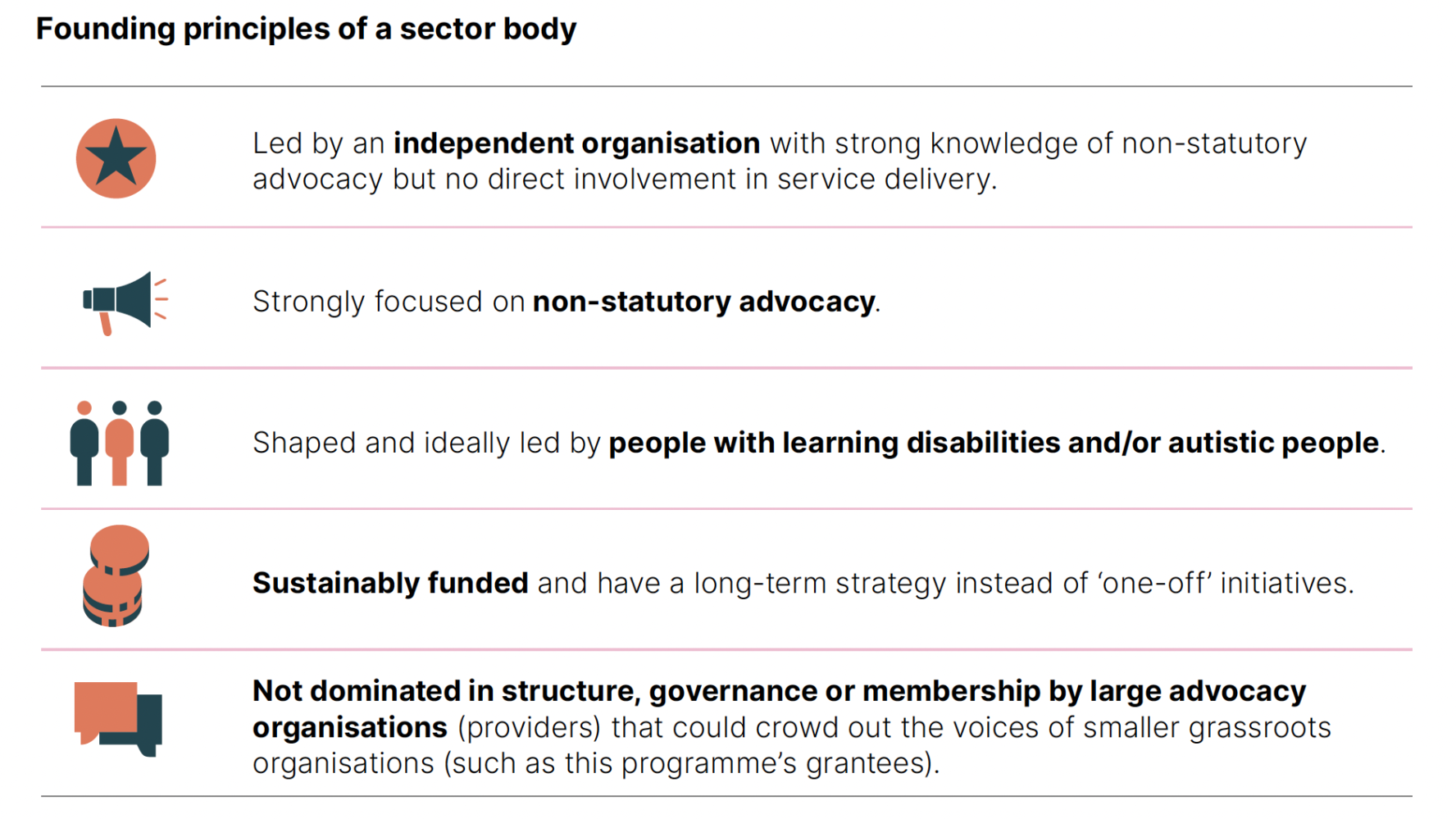
If implemented well (see below for the founding principles), such a body could serve as a collective voice for advocacy, help unite a fragmented sector, and make a stronger case for central government funding.
It could also support the sector in addressing the gaps it currently faces around identifying and applying for funding opportunities, training and professional development for staff, and accessing peer learning and collaboration opportunities.
We suggest that any future sector body addresses the considerations below to achieve buy-in and add value:
- Securing long-term funding
- Championing different types of non-statutory advocacy
- Transparency on co-design with experts by experience
- Creating wider buy-in and trust in a fragmented landscape
- Engagement with existing networks and organisations
Our analysis suggests this is a crucial step in ensuring continuity for grantees and could also create meaningful employment opportunities for experts by experience.
In parallel, the sector should remain alert to emerging place-based opportunities (e.g. neighbourhood health programmes, TNLCF’s Community Wealth Fund, the Community Enterprise Growth Plan, Community Help Partnerships, and collaboration with local community foundations).
Over the longer term, advocacy organisations could consider trialling social investment approaches such as SOPs.
The sector is likely to need substantial support around market readiness and outcomes design to explore this route.
Scotland and Wales have already established a supportive legislative framework. A future sector body could play a role in campaigning for this legislation, similar to SIAA’s role in Scotland.
Based on our estimates, a national roll-out of independent advocacy services across England could cost approximately £45.7 million over five years. This would help fund at least one advocacy service in every area.
Such a roll-out could play a transformative role in securing the future of non-statutory advocacy as well as supporting people with learning disabilities and/or autistic people to live more independent and fulfilling lives.