
A roadmap for system change

System change is hard.
As we explored in our Changing lives, changing systems series of case studies, the distance between where you are and where you want to get to can be overwhelming; your theory of system change can be highly complex; and the pathway forward, unclear and ever-changing.
To help address this Social Finance created a roadmap to help help system change leaders turn their ambitious goals into a manageable work plan, and offer some prompts for making meaningful progress at each step.
Our system change roadmap
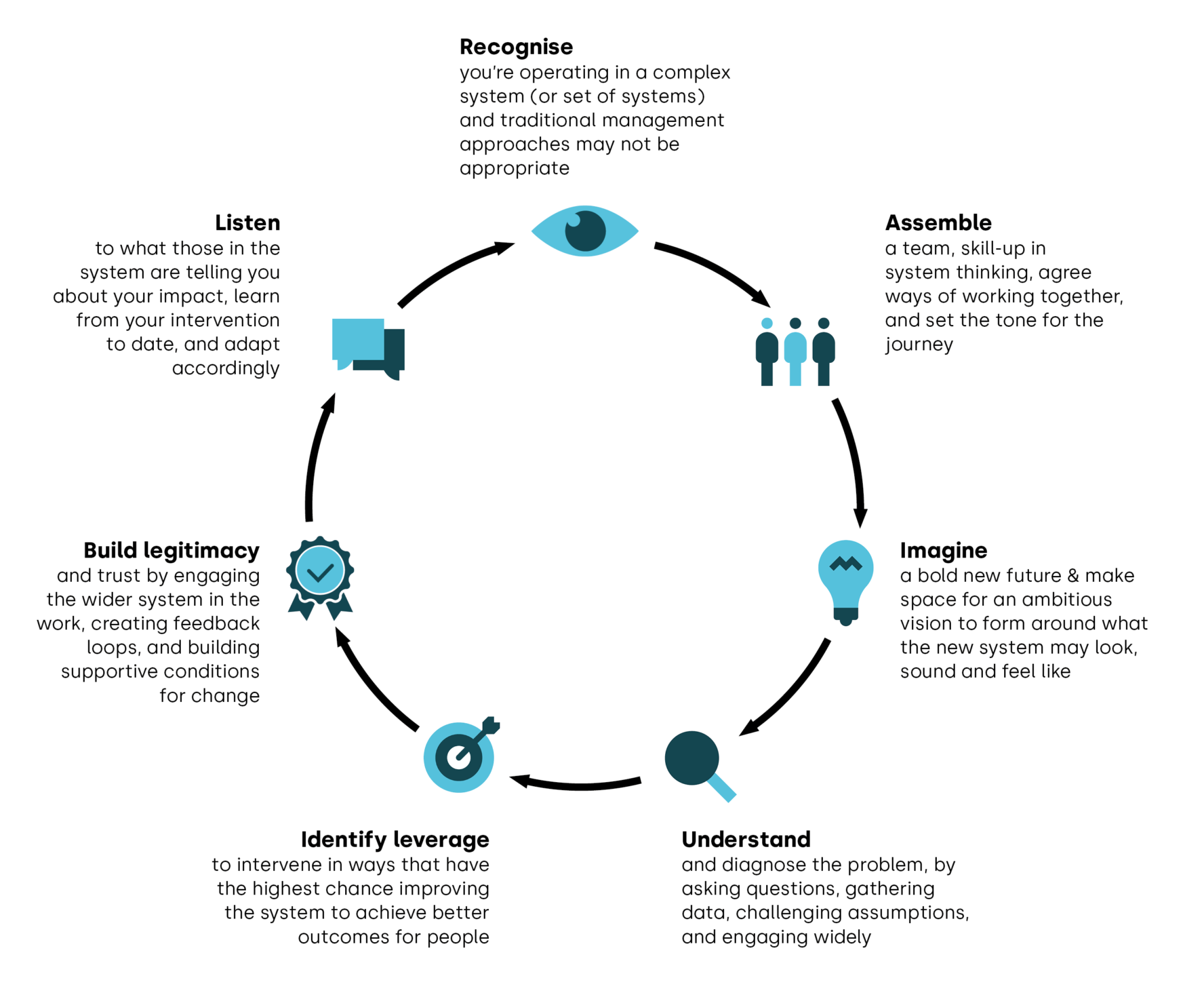
Questions to ask at each stage
Recognise you are working in a complex system
1. Does this problem require a ‘system’ approach? Why?
2. What mindset do you need to cultivate coming into this work?
3. What ‘sub systems’ make up the bigger system the problem is situated in?
4. What role do you play in the system and the problem in question?
5. Where does power lie?
Assemble a team and set the tone for the journey.
1. Do you have the right people in the room? How do you know?
2. Do you have the right skills, tools and approaches to system work?
3. What values will guide your work and partnership?
4. What’s your vision for the work? How are you setting the ambition?
Imagine a bold future and be ambitious.
1. What do you want the new system to look, sound, feel like?
2. Whose input have you sought in imagining this new system?
3. What mechanisms are in place to help you think outside the box and move beyond status quo thinking?
Note: you can use our routes to scale framework to help articulate your vision
Understand and diagnose the problem in depth.
1. Do you deeply understand the system and the root causes of the issues you’re trying to address?
2. Can you identify what beliefs and culture are driving the current system?
3. Have you thoroughly tested your assumptions?
4. How widely have you consulted? With whom? Have you involved people with lived experience?
Identify high leverage points
1. What are the key leverage points you will intervene in and why?
2. How have you determined that these are the right leverage points?
3. What is your updated hypothesis for what will generate the biggest impact?
Note: you can use our routes to scale framework to identify high leverage points
Build legitimacy and trust by engaging the wider system in the work.
1. Does everyone in the local system know what you are doing and why?
2. Are you building system-wide language and common infrastructure?
3. Are mechanisms in place to give voice to those the planned changes will impact?
4. How will you know that changes you’re making are ‘good’?
Listen, learn, adapt.
1. Who are you listening to about the impact of the work? At the individual level? At the service level? At the system level?
2. What are you learning and how are you learning it?
3. How is your system adapting to what you’re learning?
Why use our system change roadmap
There are many system change planning tools out there. Ours offers an emphasis on mindset, adaptation, and building credibility. While we’ve taken inspiration from many of the existing tools and models out there on planning system change (see for example, Omidyar Group’s systems practice), our roadmap was adapted based on our experience supporting local system change partnerships to make progress against goals on the ground.
We wanted to emphasise three things:
- The role of mindset. Our approach invites teams to reflect on the nature of system change work before they kick off. We saw that in practice, too many teams dived into strategy and planning without taking the time to consider the nature of the changes they were trying to make, or to build a common understanding of how system change work is different to ‘business as usual’ programme planning.
- The non-linear nature of the work. We feel it is important to situate the work in a ‘perpetual middle’, and emphasise that there may be many loops around the cycle as you learn, adapt and re-orient.
- The importance of building legitimacy. A key difference between the system change work plans that we saw succeed, and those which struggled to have an impact, was how much legitimacy the plan had with stakeholders. We gave ‘legitimacy building’ its own step to emphasise how crucial this is to success.
In practice, our system change roadmap might be useful for you if:
- You’re designing a system change workplan and want to self-assess where you’re up to on your system change journey (and what workstreams to prioritise). The tool can help you to reflect on which step of the journey you’re at, or where you might need to double back to do some more work at a previous step. Some areas we worked with thought they were ready to ‘identify leverage’ and start allocating resources to specific workstreams, but using the tool, they realised a need to prioritise ‘understanding’ the system more deeply first, before committing to a specific workplan.
- You want to equip your team to make meaningful progress at each stage of the journey. The tool includes a set of questions and resources suggestions at each step to help you think deeply about your system and how to change it. You can use these resources to sense-check your strategy, build a robust workplan, or deep dive on specific issues.
- You need to re-think who to involve in your planning. System change can’t be achieved in a silo. You can use the tool to think about who else might need to be around the table at each step to be making meaningful progress.
What’s next?
There is still a lot that we’re learning about how best to describe the journey to changing systems. To help us refine this tool further and better reflect a range of system change programmes, we’d be interested in hearing from you:
- What stages might be missing from the roadmap?
- For those of you who have already embarked on a system change journey, does this reflect your experience?
- What have you learned from your system change journey?
We have also published a white paper, Navigating system change evaluation, which looks at how we can know whether we are making progress.
Get in touch
If you’re interested in finding out how we can use this tool to support you on your system change journey, please get in touch.
Contact us