
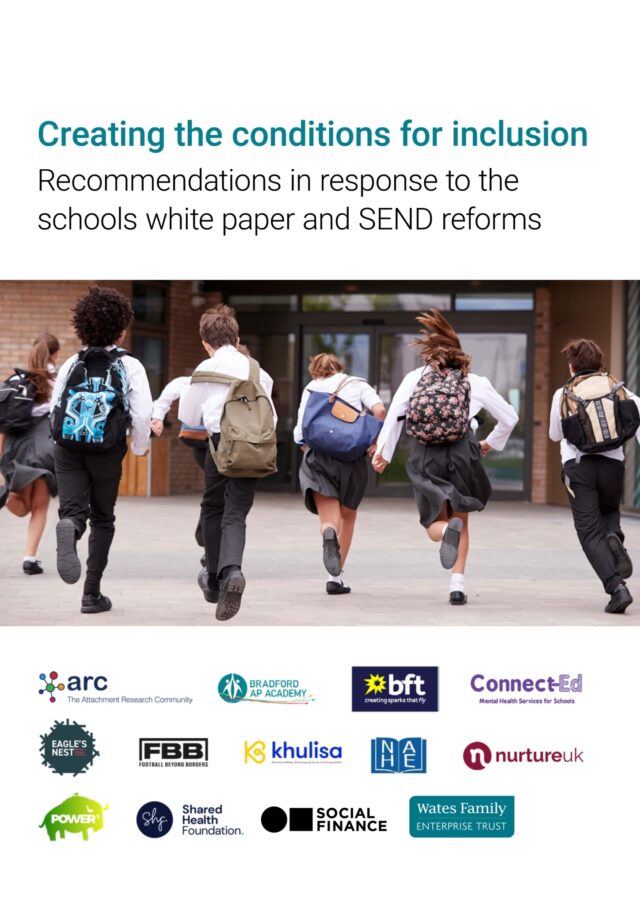

Creating the conditions for inclusion
In response to the government’s Every Child Achieving and Thriving white paper and SEND reform proposals, Social Finance, with support from Wates Family Enterprise Trust, facilitated a series of workshops bringing together organisations from across mental health, alternative provision, youth support, school leadership and inclusion.
Tags
The current state of inclusion
England’s education system is facing multiple pressures: more children with complex SEND are being educated in special schools, more pupils are being placed in alternative provision, severe absence has risen sharply, the primary attainment gap is widening for disadvantaged children and those with SEND, and almost one million young people are Not in Education, Employment or Training (NEET).
The Every Child Achieving and Thriving white paper and the special educational needs and disabilities (SEND) reforms set out the government’s vision for creating inclusive schools, including the intention to reduce reliance on expensive alternative and specialist provision and keep more pupils in mainstream schools.
The submission
The submission was collectively written by a cross-sector group across mental health, alternative provision, youth support, school leadership, and inclusion. The group includes organisations with direct experience of supporting children and young people, working with schools, local systems and beyond; advocating for more inclusive approaches to education.
Led by Tom Davies and Shaun Reeve, Social Finance’s inclusive education experts, the group has developed three practical recommendations for embedding inclusion more firmly in education, so that every child can thrive:
1. Place inclusion at the heart of young people’s school experience
The group recommends all schools have an Inclusion and Participation Scorecard that acts as a benchmark for inclusion and enables schools to identify areas for improvement.
Local authorities have a strengthened role in inclusion, but need to have clear lines of accountability with multi-academy trusts (MATs). We propose statutory Local Inclusion and Participation Agreements (LIPAs) for MATs to clarify relationships and processes to embed inclusion.
2. Build inclusive practice into every school
By developing an Inclusive Practice Framework, which needs to recognise that while inclusion applies to all children, those with additional needs will need targeted support.
The framework should contain best practice guidelines, including evidence-based approaches such as relational practice and trauma-informed and nurture approaches.
Schools will need to be supported to implement inclusive practices, through training provision, clarity on leadership responsibilities, funding and a review of the impact on teacher workload.
3. Value and integrate vocational pathways to broaden what success looks like for every young person
At the heart of this call for vocational learning to be given equal value to academic pathways is the group’s focus on a system that makes it possible for young people to achieve their personal aspirations:
“A young person who wants to be an electrician, or a construction worker, or a healthcare assistant, should be able to get there through their education without being blocked at every turn by a system designed for a different destination.”
Currently there is a mismatch in that vocational qualifications don’t appear in schools’ attainment statistics. So, schools that offer them are more inclusive, but are likely to perform below the national average.
Taken together, these recommendations are designed to deliver lasting, system-wide change and ensure that the government’s inclusion aspirations are achieved by:
- reforming the incentives that shape school behaviour,
- building the practice and infrastructure that schools need, and
- ensuring that vocational routes are recognised as equally valid paths to success.
Without these changes, children and young people will continue to fall through the gaps of a system that is not sufficiently responsive to their needs.
Related Publications