
A beginner's guide to social impact investing
Tags

Jana Bakunina, Social Investment Lead, (centre) in September 2025.
What is impact investing?
The Global Impact Investing Network’s definition of impact investment is widely regarded as the industry standard.

Impact investments are made with the intention to generate positive, measurable social or environmental impact alongside a financial return.
The Global Impact Investing Network (GIIN)
There are three key attributes of the GIIN definition:
1. Intentionality
This refers to impact investors’ intention to create specific social and/or environmental outcomes from their investment.
2. Measurability
This requires a clear process and framework in place to measure the impact performance of the investment.
3. Financial returns
This distinguishes impact investment from philanthropy, as investors seek to make financial returns from their investment.
Impact investing starts with the problem we want to solve.
It may be the climate crisis or a social issue, such as homelessness, lack of affordable housing, inequality in health outcomes, lack of skills, poverty, loneliness or the mental health problems experienced by children and young people.
Social impact investing, or social investing, is a subset of impact investing that uses capital as a tool to solve social issues.
Social investors are asset owners or fund managers seeking to make positive social impact and make a financial return on their investments.
Asset owners could be non-profit endowments, foundations and charities who may accept concessionary returns on their capital (below the market rate) – more on that below.

What is impact and how does investment lead to desired outcomes?
A good place to start to understand impact are Sustainable Development Goals (SDGs), which were adopted by the United Nations in 2015. There are 17 SDGs, which are recognised as interdependent.
Impact measurement is the process of assessing the changes in social or environmental outcomes caused by an investment or an organisation.
For a deep dive on impact measurement, Impact Frontiers, a peer learning and a collaboration hub, is a good platform, which continues the industry-wide work to create practical tools for investors to manage impact and integrate it with financial data and analysis.
Theory of Change
Investors and their investees use a Theory of Change to illustrate how investing capital leads to desired outcomes – mapping causal pathways from the investment into inputs and activities to the achievement of impact outcomes.
For example, investing in preventative health and social care aims to improve overall health and wellbeing.
A Theory of Change is essentially a roadmap that explains how activities are expected to produce desired results within specific impact goals.
It’s a useful framework for designing and evaluating solutions to complex social challenges.
Financial returns from impact investing
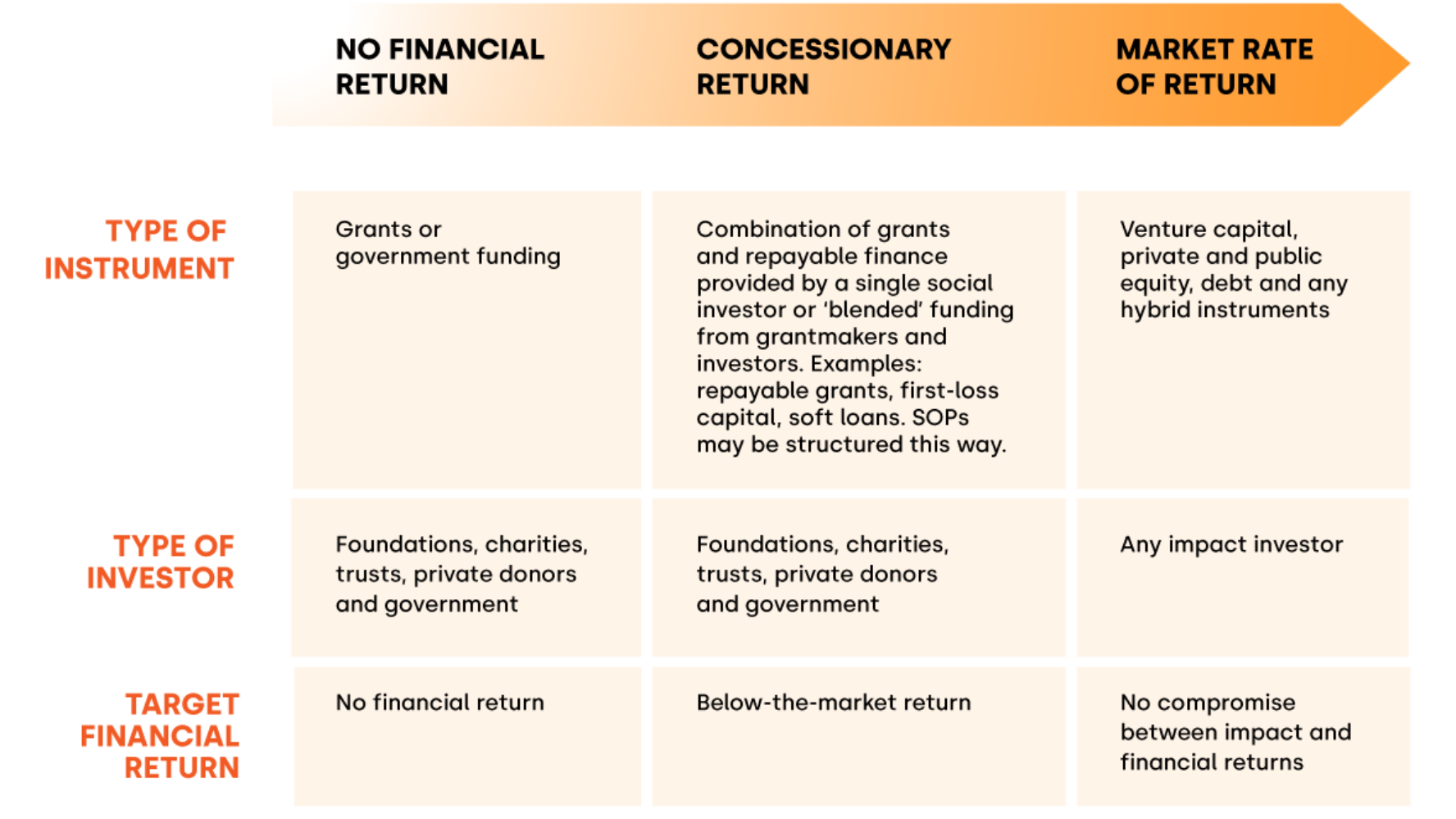
When we talk about financial returns, it’s useful to consider the spectrum of returns: from grants or government subsidies, where investors do not expect to get their money back; to market-rate financial returns, where investors want to achieve the same returns as non-impact investors.
Do investors need to sacrifice financial returns to achieve impact?
Most impact investors do not sacrifice financial returns to achieve impact goals. According to the latest UK impact investment market report published by the Impact Investing Institute in 2024:
73% of impact fund managers said they had never targeted concessionary returns
68% of respondents reported financial returns in line with or outperforming targets in 2023
Nevertheless, there are certain investors who may prioritise impact goals over financial ones and who may be willing to accept below-market returns.
The role of philanthropy
Philanthropy plays an important role in impact investing. Charitable grants can fund the design work and build capacity.
For example, Macmillan Cancer Support funded the initial development work to design Neighbourhood Transformation Funds.
Government funding can be used to absorb risk, acting as a ‘first loss layer’.
Concessionary impact capital
In some finance structures, capital from the government or philanthropic investors is‘blended’ with private capital to reduce the risk for private investors. When concessionary capital acts to incentivise private capital investment, it is called‘crowding in’.
When social investors, such as charities, trusts and foundations fund social projects, they often prioritise impact over financial return. In certain situations, social investors may be willing to provide capital in the form of repayable grants or low-interest loans, accepting below-the-market financial return.
The impact investment market in the UK
How big is the UK impact investment market?
The Impact Investing Institute also calculated that the impact investing market grew by 10% compound annual growth rate in 2020–2023, outpacing the broader UK asset management sector, which had an annual growth rate of between ‑2% to 0% over the same period.
What types of instruments are available to investors?
The most common asset classes available to investors are both debt and equity: loans (including social housing) and equity (including venture capital and private equity).
Social and affordable housing is by far the largest asset class in impact investing in the UK – valued at £6bn at the end of 2024.
Other forms of repayable finance are lending by ethical banks, charity bonds and non-bank social lending, where social lending funds or Community Development Financial Institutions (CDFIs) provide loans to organisations, such as social enterprises or charities, typically overlooked by traditional lenders.
On the equity side, there are private equity and venture capital funds that invest to achieve positive impact alongside financial return. There are also some publicly traded equity funds that invest to achieve climate, environmental or social impact goals.
While some investors put money directly into impact ventures or lend capital to social enterprises, many invest capital into funds managed by expert managers. This is a common strategy in finance in general to achieve portfolio diversification.
Social Outcomes Partnerships
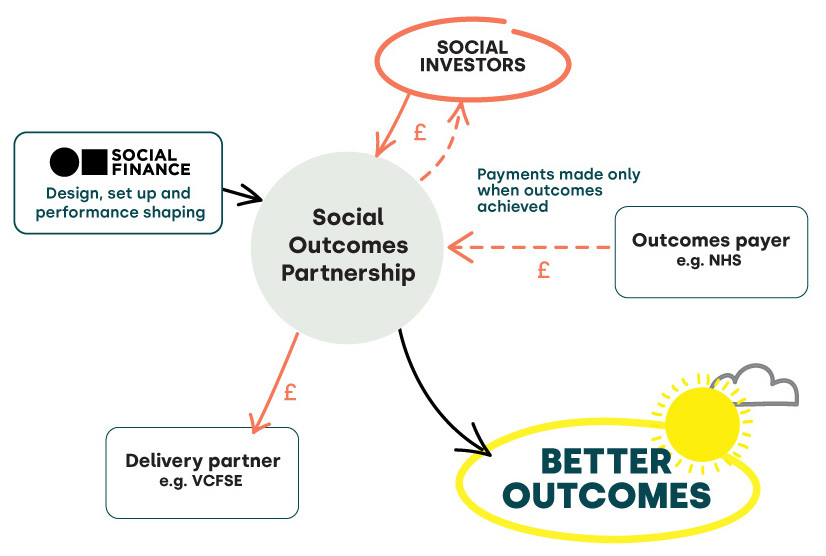
We are often asked about Social Outcomes Partnerships (SOPs) – also known as Social Outcomes Contracts (SOCs) or Social Investment Bonds (SIBs), because Social Finance designed and launched the very first SIB in 2010. They are a type of contract where a private investor provides upfront funding for an intervention to tackle a social issue, and the government repays the investor once specific outcomes have been achieved.
An investor provides upfront capital and takes on the risk. Unlike grants, this is repayable finance, which means it can be reinvested again and again.
For public bodies (outcomes payers), it is a low-risk and a cost-effective way to innovate because investors get repaid only if the specific outcomes are achieved.
Ultimately, the goal of SOPs is to design, implement and sustain long-term programmes that lead to better outcomes. This is achieved by linking payments to end-user outcomes as opposed to inputs, outputs or activities.
SOPs may be designed to offer partial capital return to investors, although most SOPs aim to achieve positive financial return.