
Wellcome Global Learning Network
Tags

Millions of people across the world are living with mental health problems, and data about their experiences gathered over time can unlock valuable insights to support early intervention. Improved ways of managing and analysing longitudinal qualitative data sets could help achieve these insights.
The Wellcome Global Learning Network on Mental Health was a pioneering initiative funded by Wellcome and delivered by Social Finance.
The pilot brought together a diverse multidisciplinary group from across the world to address shared challenges in mental health research and to realise the potential of longitudinal qualitative data.
It aimed to address technical, methodological, and ethical barriers to generating research insights that support early intervention and improved outcomes for people living with depression, anxiety or psychosis.
We worked on the programme between October 2024 and January 2026 – from pilot design and recruitment through to the final evaluation.

Being part of a global, multi-disciplinary collaborative team to deliver an innovative output as part of a wider learning network has been hugely rewarding. Sharing ideas and perspectives with people with shared goals in a collegiate way is such a great source of energy. Building connections that will last well beyond this pilot is a testament to the way that this learning network was curated.
Alex Hutchison, Focus Area 1 Co-lead
Three Focus Areas
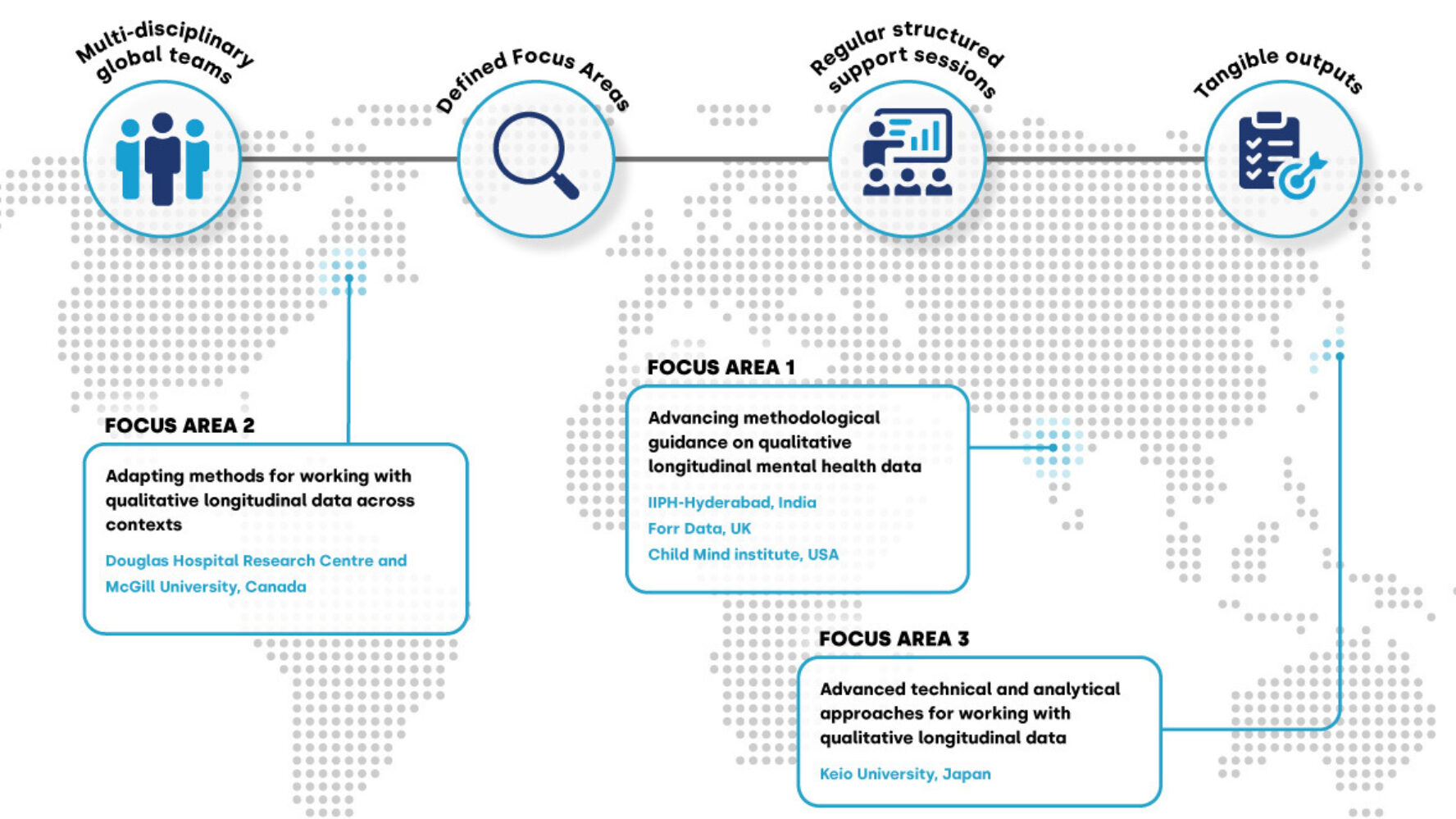
The Learning Network was designed as a collaborative and applied learning model. It focused on working with real datasets and real-world constraints, and producing tangible outputs to benefit the wider research community. Work was organised around three Focus Areas, each of which was awarded £40,000 to address a specific challenge around working with qualitative longitudinal mental health data.
The team developed a Human-Centred Metadata Canvas – a guidance tool designed to support the capture and sharing of contextual information relating to qualitative longitudinal mental health data, to better inform data users and the insights they can draw.
This Canvas goes beyond traditional technical metadata by prompting data managers to capture the social, ethical, personal, and situational factors that shape how data are collected and opportunities for their reuse. The tool is particularly relevant for open-text mental health datasets, where study context, participant characteristics, and research approaches can strongly influence how individuals with lived experience share sensitive and personal information.
The development process included co-creation with a global group of experts across qualitative, longitudinal, and mental health research, and pilot-testing using a real-world dataset.
This pilot project established an integrated framework for secondary analysis of qualitative longitudinal mental health data.
Following a rapid review of literature, the team developed a set of consensus-based recommendations for qualitative secondary data analysis, finalised through an adapted Delphi process involving a team of researchers and young people with lived experience across Australia, Canada, India, Nigeria, Singapore, UK and USA.
They then created an accompanying toolkit to guide researchers through the process of locating accessible data and conducting secondary analysis.
They evaluated the feasibility by testing on three qualitative datasets on early intervention services for psychosis in Canada, India and Singapore.
Following a literature review on the applications of Natural Language Processing (NLP) in mental health, the team conducted feasibility testing by exchanging analytical methods across five international datasets from Japan, Denmark, the USA and Vietnam.
These experiments demonstrated that direct model transfer across cultures and modalities was largely infeasible due to significant variation in data formats, clinical metrics and cultural differences, highlighting the need for a framework that focused on shared linguistic features and adaptable methodological approaches, rather than a universal model.
Building on these insights, the team developed a prototype of the Universal NLP Analysis Pipeline, alongside a set of practical guidelines for enhancing longitudinal psychiatric data analysis.

Longitudinal data hold unique power to drive mental health innovation. The Learning Network brought global, multidisciplinary partners together to unlock that potential, and we are exploring ways to solidify the real-world impact of these insights.
Lampros Bisdounis, Technology Manager, Wellcome Trust
Key features of the Learning Network were:
Working alongside a diverse group of professionals and stakeholders to address shared challenges in mental health research.
Helping to develop innovative tools, frameworks, and approaches that advance mental health research and create actionable solutions for real-world impact.
Learning Network members had access to training, learning forums, and networking sessions to foster collaboration and innovation across disciplines.
Connection with peers from across disciplines, geographies, and career stages, opening new opportunities for collaboration and growth.
Key insights from the pilot
1. The learning network model is a powerful approach to tackling complex, systemic problems
The pilot demonstrated that a global, multidisciplinary learning network can address problems that are challenging for any single organisation to tackle. The model provides the opportunity and resources for collaborators from diverse disciplines and geographies to come together and invest in developing open source outputs that benefit a wider community.
2. Investing time into scoping key focus areas for each phase helps teams hit the ground running
The pilot highlighted the value of investing in scoping at the outset of each phase, breaking systemic problems down into component parts that can be tackled within the timeframes of the upcoming phase. This provides the opportunity to engage early with a range of multi-disciplinary experts, and to identify enablers or pre-empt potential barriers that could be addressed ahead of bringing on dedicated teams. The resulting ‘focus areas’ gave teams a clear steer for directed, solution-oriented work.
3. Global collaboration drives more contextually grounded approaches
Working across global contexts broadened perspectives and strengthened rigour, as cultural and linguistic diversity revealed nuances that enriched analysis and interpretation, for example FA3 highlighted the risk of ‘false universality’ when attempting to transfer NLP models across contexts. These differences helped teams refine more adaptable, context-sensitive methods, ultimately producing approaches that are richer, and better grounded in the diversity of real-world mental health experiences.
4. The learning network model can champion inclusive ways of working between experts by profession and experts by experience
The pilot highlighted that creating an inclusive environment for all perspectives to feed in leads to higher quality outputs that are grounded in real-world applications. The learning network model can actively support the sustained relational work, trusted environments and time needed to foster these collaborations. Key enablers include phased onboarding for participants to co-create ways of working and a shared language, and providing opportunities for expert guidance and peer support on lived experience involvement.